Chapter Eight · From measurement to meaning
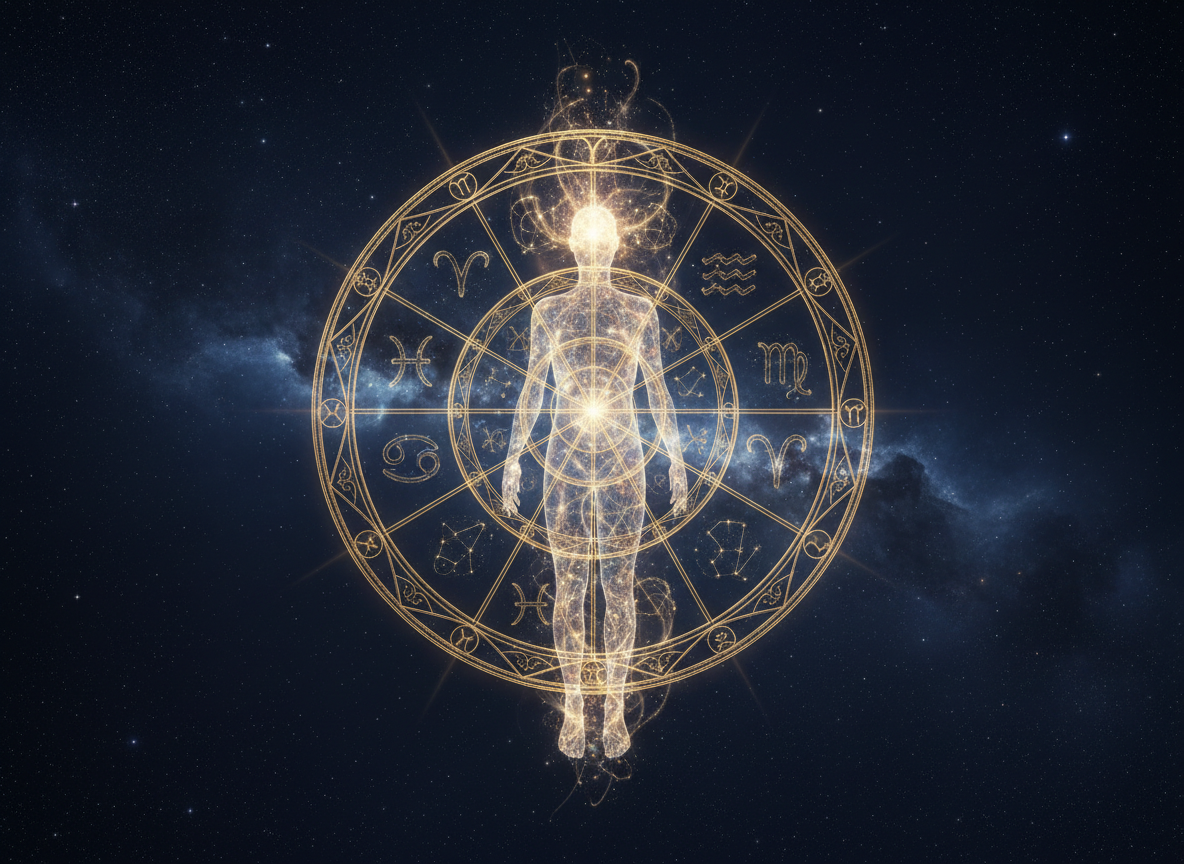
We have spent seven chapters learning how Jyotish observes and measures the sky. Now comes the first real interpretive turn: the same 360° zodiac is read as an ordered cosmic body — Kālapuruṣa, the Person of Time.

Chapter Seven gave us a disciplined rule: observe first, measure second, interpret third. We found the ecliptic, built the Bhachakra as a 360° measuring field, and saw how twelve rāśis and twenty-seven nakṣatras can occupy the same circle.
But a longitude is not yet an interpretation. Knowing that a graha lies at a particular place on the zodiac tells us where it is. It does not yet tell us why that place should carry a particular kind of meaning.
How does a circle in the sky become a language of embodied life?
Bhachakra tells Jyotish where a graha is. Kālapuruṣa begins to tell us how that position enters an ordered symbolic map of life and embodiment.
Part I · The Person of Time
What is Kālapuruṣa?
Kāla means time. Puruṣa can mean person, being or conscious principle. In Jyotish, Kālapuruṣa is commonly rendered as the Person of Time or Time personified.
The idea is simple to state but profound in consequence: the zodiac is not treated only as a neutral coordinate wheel. Its twelve rāśis are also arranged as the limbs of a cosmic body.
शीर्षानने तथा बाहू हृत्क्रोडकटिबस्तयः।
गुह्योरुयुगले जानुयुग्मे वै जङ्घके तथा॥
Bṛhat Parāśara Horā Śāstra, in its description of the rāśis, gives the limbs of Kālapuruṣa in sequence from Meṣa onward: head, face, arms, heart, stomach, hip, the region below the navel, private parts, thighs, knees, lower legs/ankles and feet.1
The same head-to-feet structure also appears in Jātaka Pārijāta 1.8 and in Horā Sāra 1.21, even though the exact anatomical wording varies slightly between texts and translations.23
The stable principle is not a single English body-part label. It is the ordered descent of the twelve rāśis from the head of the cosmic person to the feet.
Part II · The body hidden in the zodiac
From Meṣa at the head to Mīna at the feet
Read the rāśis in their natural order and the body-map descends from above to below. This is not a modern wellness overlay placed on Jyotish; it is part of the classical descriptive architecture of the signs.
| Rāśi | Common English name | Kālapuruṣa correspondence |
|---|---|---|
| Meṣa | Aries | Head |
| Vṛṣabha | Taurus | Face / mouth region |
| Mithuna | Gemini | Arms / upper region |
| Karka | Cancer | Heart / chest region |
| Siṃha | Leo | Stomach / belly region |
| Kanyā | Virgo | Hip / waist region |
| Tulā | Libra | Lower abdomen / groin region |
| Vṛścika | Scorpio | Private / reproductive region |
| Dhanu | Sagittarius | Thighs |
| Makara | Capricorn | Knees |
| Kumbha | Aquarius | Calves / lower legs |
| Mīna | Pisces | Feet |
Interactive · Turn the zodiac into a body
The circle stays the same. The interpretive layer changes.
Select a rāśi. The luminous band moves through an abstract human form so you can see the classical head-to-feet sequence without turning the lesson into a medical diagram.
Head
The natural zodiac begins at the head of Kālapuruṣa and then descends through the body sign by sign.
This visualization is a teaching model. Classical texts vary slightly in the anatomical words they use, so the emphasis here is the stable top-to-bottom sequence rather than pretending every source uses identical terminology.
Part III · Why a body?
Kālapuruṣa changes the kind of question Jyotish asks
A coordinate system asks: Where is the graha?
An interpretive system asks a second question: What kind of domain is being activated by that location?
Kālapuruṣa does not replace the astronomy. It sits on top of it. The ecliptic, longitude and rāśi boundaries still establish position. The body-map supplies an ordered symbolic correspondence through which position begins to participate in interpretation.
Astronomy gives location. Kālapuruṣa gives correspondence. A horoscope later combines that correspondence with Lagna, bhāvas, grahas, lordship, strength and time.
A rāśi is not “just” a body part
Meṣa does not mean only “head,” and Mīna does not mean only “feet.” The Kālapuruṣa body-map is one classical layer among many. A sign also carries qualities, element, modality, rulership and other attributes. Good interpretation comes from synthesis, not from isolating one correspondence.
Part IV · Body and cosmos
The wider Indian image of cosmos as person
Reel 8 used the familiar maxim yat piṇḍe tat brahmāṇḍe — often paraphrased as “what is in the embodied microcosm is reflected in the cosmos.” It is a useful traditional expression of the intuition behind the body–cosmos correspondence, but its exact textual provenance is less straightforward than popular quotations often imply.
A firmer Vedic anchor for the broader cosmos-as-person image is the Puruṣa Sūkta of the Ṛgveda (10.90). It describes an all-encompassing Puruṣa whose body participates in the ordering of the cosmos.4
That does not mean we should claim that the later technical Kālapuruṣa mapping in Jyotish is simply “derived from” this hymn. The safer and more useful point is conceptual: Indian thought repeatedly explores correspondences between person, world and cosmic order.
Puruṣa Sūkta gives philosophical context for the cosmic-person image. Classical Jyotish texts give the specific rāśi-to-body mapping used in Kālapuruṣa.
Vedansh Jyotish Circle
Want to ask questions, discuss Kālapuruṣa, or talk to Vedansh?
Join the Vedansh Jyotish Circle on WhatsApp. Bring your questions from this chapter, discuss what you are learning, and stay connected as the curriculum moves from Kālapuruṣa into the spring point and ayanāṃśa.
A learning conversation · No prediction spam · Leave anytime
Before you join
This is a conversational WhatsApp group for Jyotish learners. Group members can see one another’s WhatsApp phone numbers.
Part V · Universal pattern, personal chart
Kālapuruṣa is universal. Your Lagna makes the zodiac personal.
This is where Chapter Two returns.
The natural sequence of Kālapuruṣa begins with Meṣa and moves through the twelve rāśis in order. But your birth chart is not created by placing Meṣa permanently in the first house.
Your Lagna is the rāśi rising on the eastern horizon at the birth moment. That local horizon gives the zodiac a personal orientation. The same universal circle is therefore arranged differently for different people because different signs are rising.
Kālapuruṣa gives the universal architecture. Lagna tells us how that architecture is oriented for one individual.
This is why the curriculum began with the eastern horizon long before asking you to interpret a chart. When we later enter the kundli itself, the houses will make far more sense because you already understand both layers: the universal zodiac and the personal rising point.
Part VI · What this lets us read — and what it does not
The body-map is a framework, not a shortcut to prediction
A beginner can easily turn correspondences into mechanical claims: “a planet is in this sign, therefore this body part must suffer,” or “this rāśi means this exact event.” That is not how serious Jyotish should be learned.
Classical texts themselves move beyond a simple one-to-one map. Bṛhat Parāśara Horā Śāstra later brings in the Lagna, bhāvas, decanates and benefic/malefic influences when discussing bodily indications.5
Rāśi
Provides a zodiacal sector and a field of qualities.
Lagna
Orients the universal zodiac to one birth moment and place.
Bhāva
Introduces a distinct house-based domain of lived experience.
Graha
Brings agency, function and specific planetary symbolism into the reading.
Timing
Dashā, transit and other timing systems ask when a pattern becomes active.
So the Kālapuruṣa body-map should be treated as an interpretive grammar, not as a medical diagnostic tool or an excuse for deterministic claims.
Part VII · A modern historical aside
Giorgio Piccardi: an analogy, not proof of astrology
Reel 8 briefly mentioned the Italian chemist Giorgio Piccardi. He investigated whether some physical and chemical systems might vary with wider environmental, solar or cosmic conditions. His claimed “Piccardi effect” became controversial, and later historical discussions note that the result was widely regarded as unconvincing.6
That makes Piccardi interesting as a historical example of scientists asking whether terrestrial systems can be sensitive to larger environments. It does not establish Kālapuruṣa, Jyotish or astrological interpretation experimentally.
Analogy is not validation
Where modern research offers an interesting parallel, we can examine it. But a parallel should never be presented as scientific proof of a classical astrological doctrine.
Close the notebook
Six ideas to remember
Bhachakra and Kālapuruṣa are not competing ideas.
Bhachakra provides the 360° measuring field; Kālapuruṣa adds an interpretive body-map to that same field.
Kālapuruṣa means the Person of Time.
The twelve rāśis are arranged as the limbs of an ordered cosmic body.
The sequence runs from head to feet.
Meṣa begins at the head; Mīna completes the natural zodiac at the feet.
Classical texts differ slightly in anatomical wording.
The stable principle is the ordered top-to-bottom correspondence, not one modern English label.
Kālapuruṣa is universal; Lagna is personal.
The rising sign orients the same zodiac differently for each birth moment and location.
Interpretation requires synthesis.
Rāśi, Lagna, bhāva, graha, strength, lordship and timing must eventually be read together.
What is the Spring Point?
We now know that Jyotish can measure a zodiac and then read that zodiac symbolically. But every measuring system still needs a beginning. Western tropical astrology places that beginning at a very particular point on the ecliptic — the spring point. In Chapter Nine we will build that point geometrically from the ecliptic and the celestial equator.
Sources and reading notes
Classical mapping first, analogy second
The article separates the classical Jyotish body-map from broader philosophical context and from modern historical analogies.
- Bṛhat Parāśara Horā Śāstra, Zodiacal Rāśis Described, verse 4. Gives the limbs of Kālapuruṣa in sequence with the twelve rāśis.
- Jātaka Pārijāta 1.8. Describes the parts of the Person of Time from Meṣa onward.
- Horā Sāra 1.21. Gives a parallel head-to-feet mapping of the rāśis in Kālapuruṣa.
- Ṛgveda 10.90, Puruṣa Sūkta. Used here only as broader Vedic context for the cosmic-person image, not as proof of the later technical Jyotish mapping.
- Bṛhat Parāśara Horā Śāstra, Effects of Tanu Bhāva, verses 11–15. Shows that bodily indications in horoscopy are developed through additional layers such as Lagna, decanates and planetary influence.
- Giuliano Preparata, “Giorgio Piccardi: A Forgotten, But Great, Italian Scientist”. Historical discussion of Piccardi and the disputed “Piccardi effect”; cited as context, not validation of astrology.