Vedansh Jyotish Library · Chapter Three
Your breath may be following the Moon more closely than you think. Chapter Three follows Chandra from a 27.3-day journey across the stars into tithi, Ida and Pingala—and finally into manas, the mind through which life becomes personal.

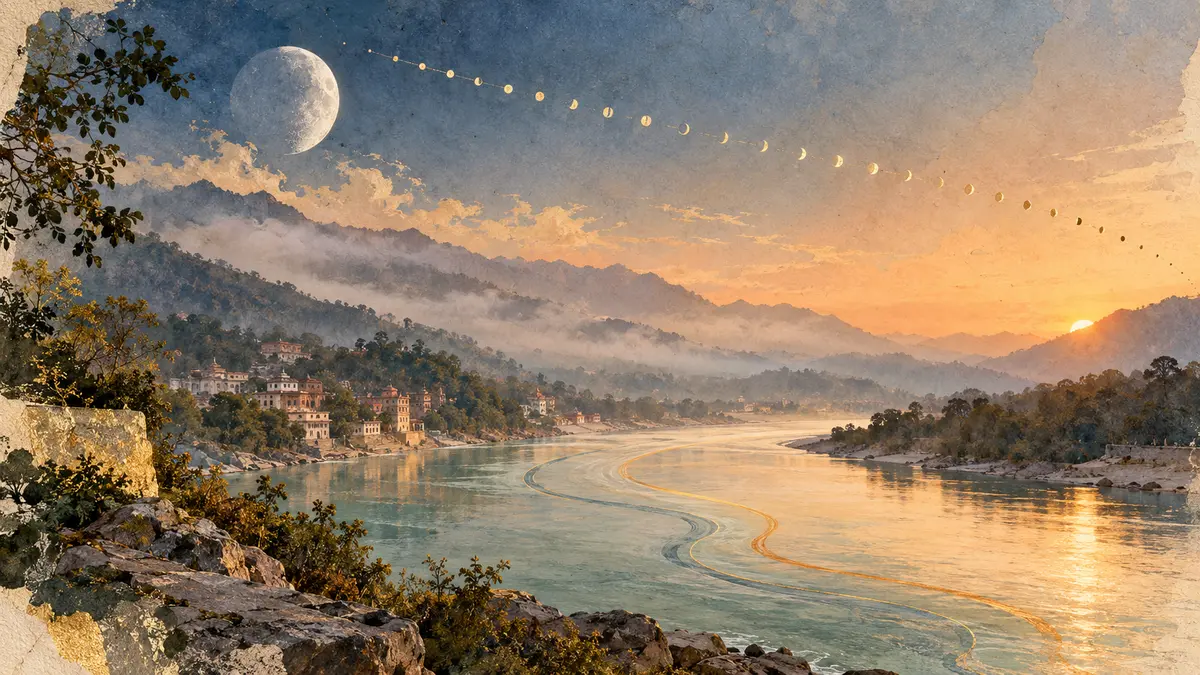
Stand beside the Ganga before sunrise and the sky can hold two rhythms at once. The eastern horizon is beginning to warm, while the Moon still belongs to the night. One gives us the beginning of the day. The other is already moving against the background of stars.
In Chapter Two, we saw how Lagna makes the sky personal: an exact eastern horizon for an exact place and birth moment. Now we follow the Moon. Chandra changes quickly enough for its movement to become visible from one night to the next—and Jyotish gives that changing rhythm an extraordinary place in the language of time, breath and mind.
What could the Moon’s movement in the sky possibly have to do with the rhythm of your breath—and why does Jyotish connect Chandra so deeply with the mind?
The Moon moves roughly thirteen degrees and twenty minutes through the zodiac each day. In about 27.3 days it completes one sidereal revolution around Earth. Śiva Swarodaya then asks us to look inward: can lunar time also be observed through the changing flow of breath?
Try it now · 20 seconds
Which nostril feels clearer at this moment?
Breathe normally. Do not close either nostril or pull the breath. Simply notice where the air seems to move more freely.
Part I · Watch the Moon move
About 13°20′ a day. About 27.3 days around the Earth.
Begin with the simplest astronomical observation. Against the distant stars, the Moon moves eastward by a little over thirteen degrees per day on average and completes a sidereal circuit in about 27.3 days.12
Jyotish divides the stellar zodiac into twenty-seven equal nakṣatra fields of thirteen degrees and twenty minutes each. The Moon’s average daily movement is close to one such span, creating a striking 27-fold lunar rhythm across the sky.
This is why the Moon becomes such a natural clock for the nakṣatra cycle. Night after night, Chandra moves into a new stellar context. The Sūrya Siddhānta preserves a classical astronomical framework for the nakṣatras and their stellar coordinates.3
Interactive · The sidereal rhythm
Follow the Moon across 27 star-fields
Move through one illustrative 27.3-day circuit. The model uses equal nakṣatra sectors and average motion so you can see the architecture clearly.
The illustrative circuit begins at 0°. This is a teaching model, not the Moon’s current position.
Illustrative model only. It assumes uniform motion through 27 equal sectors. Real lunar longitude varies, and an actual nakṣatra requires an ephemeris, date, time, location and the chosen sidereal reference.
Why do you also hear 29.5 days?
Because two different lunar clocks are being measured. About 27.3 days is the Moon’s return to the same direction against the stars—the sidereal month. About 29.5 days is the return from one lunar phase to the same phase again—the synodic month. Earth has moved around the Sun during the Moon’s orbit, so Chandra needs a little more time to recover the same Sun–Moon geometry.1
Part II · A rhythm echoed in the body
The same number appears in a very different human rhythm
A large digital-health study from Tokyo Medical and Dental University analysed data from roughly 310,000 Japanese women, covering more than six million menstrual cycles. Mean cycle length changed with age: it reached 30.7 days around age 23, decreased to 27.3 days around age 45, and then increased again.7
A curious numerical echo
The 27.3-day value appears here as an age-specific population mean—not as a universal human cycle. Still, it gives us an intriguing numerical correspondence with the Moon’s 27.3-day sidereal revolution.
The correspondence does not by itself establish that the Moon causes menstrual timing. But it opens a fascinating question: long before digital datasets existed, did traditional systems notice relationships between lunar time and rhythms inside the body?
That question takes us directly into Śiva Swarodaya.
Part III · When lunar time enters the breath
Śiva Swarodaya maps tithi to Ida and Pingala at sunrise
The Moon’s 27.3-day revolution is measured against the stars. Tithi measures something different: the changing angular relationship between the Moon and the Sun. Each twelve-degree increase in their longitudinal separation completes one tithi. Fifteen tithis form Śukla Pakṣa, the waxing or bright half, and fifteen form Kṛṣṇa Pakṣa, the waning or dark half.
Śiva Swarodaya carries this lunar calendar into the breath. In the received sequence, the first three tithis of Śukla Pakṣa begin at sunrise with Ida—the left nostril, Chandra Swara, the lunar current. The next three begin with Pingala—the right nostril, Surya Swara, the solar current. The starting current alternates in blocks of three tithis. Kṛṣṇa Pakṣa begins with the reverse order.4
Interactive · Moon phase and breath
Choose a fortnight and tithi. What does the traditional map expect at sunrise?
This is the sequence described in the Śiva Swarodaya. Move the tithi slider, then compare the expected swara with your own unforced observation at local sunrise.
Chandra Swara · the lunar current
For tithis 1–3 of the waxing half, the traditional sunrise sequence begins with Ida. The text then describes alternation through the day; it does not say one nostril remains dominant all day.
Observe rather than force: this interactive shows the sunrise sequence described in Śiva Swarodaya. Compare it with your own unforced observation over several mornings and let the pattern become experiential.
Moon gives the phase. Sun gives the sunrise. Breath reveals the rhythm inside you.The Moon–Sun–Breath Triad · Chapter Three
This is the hidden triad at the centre of the lesson. Chandra tells us where we are in the lunar phase. Surya gives the moment of sunrise. The breath becomes the place where the practitioner observes that rhythm within.
Vedansh Jyotish Circle
Want to know more, ask questions, or talk to Vedansh?
Join the Vedansh Jyotish Circle on WhatsApp. Bring your questions from this chapter, discuss what you are learning, and stay connected as new lessons are published.
A learning conversation · No prediction spam · Leave anytime
Before you join
This is a conversational WhatsApp group for Jyotish learners. Group members can see one another’s WhatsApp phone numbers.
Part IV · Chandra and Manas
Why the Moon becomes so important in Jyotish
चन्द्रमा मनसो जातः
Candramā manaso jātaḥ — “The Moon was born from the mind.” · Ṛgveda 10.90.138
मन से बना मनुष्य
Take this as a teaching reflection rather than an etymology: human life is not made only from the events that happen outside us. Manas receives an event, feels it, remembers it, compares it and gives it personal meaning. The outer world becomes our lived world through mind.
The Vedic image connects Chandra with manas. Classical Jyotish develops the same relationship: in the received Bṛhat Parāśara Horā Śāstra, the Sun is associated with ātman and the Moon with manas.9
Now the symbolism begins to feel intuitive. The Moon receives and reflects the Sun’s light. Its visible form changes continuously. It moves rapidly through the zodiac, gathering a new stellar context almost every day. Chandra therefore becomes a language for reception, responsiveness, memory, feeling, habit and the changing texture of experience.
Lagna
The rising horizon: body, situation and the starting point from which the entire horoscope is structured.
Chandra
The receiving mind: feeling, memory, attention, habit and the inner response through which experience becomes personal.
Sūrya
The central light: vitality, coherence, direction and the organizing principle of self.
Because Jyotish does not use Chandra merely as another label in the zodiac. The Moon sign—Janma Rāśi—becomes a central reference for understanding how experience is received, felt, remembered and carried within.
The rāśi containing the Moon gives one layer. Its nakṣatra gives a finer one. Its house, phase, lord, aspects, strength and planetary periods add still more. The Moon sign is therefore not the whole horoscope; it is one of the most intimate doors into it.
Lagna is the point from which life is oriented. Chandra is the rhythm through which life is received.Vedansh Astrology · Chapter Three
Part V · Go deeper
What happens when modern researchers begin observing the breath?
Modern respiratory physiology independently recognises a nasal cycle: airflow often becomes greater through one nostril and later shifts to the other as the nasal tissues alternately congest and decongest. In a 24-hour study of 33 healthy adults, dominance commonly lasted for hours and changed with sleep and posture.5
That gives us something important to work with: alternating nostril dominance is not merely a poetic idea. It is observable physiology. The next question is whether its timing shows any repeatable relationship with lunar phases or tithi.
An early attempt to study the pattern
Eight yoga trainees observed their sunrise breath for one lunar month
In 2004, Ananda Balayogi Bhavanani followed eight residential yoga trainees across one lunar cycle. Participants recorded the dominant nostril at sunrise and the group result was compared with the traditional sequence.6
Three days were indeterminate. The observations were mixed overall, although the reported full-Moon and new-Moon observations aligned with the traditional direction in that small group.
Why this is interesting: the study is far too small to settle the lunar-breath question, but it does something useful—it turns a traditional teaching into an observable pattern that future research can test more carefully.
Make the teaching experiential
For several mornings, observe the breath at local sunrise without forcing it. Note the pakṣa, the tithi and whether the left nostril, right nostril or both feel clearer. Also note obvious influences such as posture, sleep or congestion. The point is not to prove anything in one morning; it is to learn how observation becomes part of Jyotish and Swara Yoga.
Carry this chapter with you
Five ideas to remember
1. The Moon moves roughly 13°20′ through the zodiac each day on average.
2. Its sidereal revolution around Earth takes about 27.3 days.
3. Tithi measures the changing angular relationship between the Moon and the Sun.
4. Śiva Swarodaya maps the sunrise flow of Ida and Pingala to the lunar fortnight in repeating three-tithi blocks.
5. Jyotish connects Chandra with manas—the mind through which experience becomes feeling, memory and response.
Try this tomorrow morning
At sunrise, take a few natural breaths. Notice which nostril feels clearer. Then return to the interactive above, choose the current pakṣa and tithi, and compare. Write down what you notice. One observation is a moment; repeated observation becomes a practice.
The Sun—and why the zodiac has twelve signs
The Moon gives us a 27-fold stellar rhythm. The next lesson follows the Sun through the year and asks why its apparent journey became a circle of twelve rāśis.
Source transparency
Sources & Further Reading
This chapter brings together modern astronomy, classical Jyotish and Swara Yoga texts, respiratory physiology and health research so you can follow the teaching further at the source.
Astronomy and lunar measurement
- NASA Science, “Top Moon Questions”: 27.3 days for the Moon’s revolution relative to the stars and 29.5 days from new Moon to new Moon.
- National Radio Astronomy Observatory, “Variability of the Moon’s Apparent Motion Through the Sky”: average daily motion and why it varies.
- Sūrya Siddhānta, chapter VIII, translated by Bāpū Deva Śāstrī and Lancelot Wilkinson: classical coordinates of the nakṣatra stars.
Breath, tithi and physiology
- Muktibodhananda, Swara Yoga: The Tantric Science of Brain Breathing, translation of Śiva Swarodaya, verses 62–65: the three-tithi sunrise sequence of Ida and Pingala.
- Kahana-Zweig et al., “Measuring and Characterizing the Human Nasal Cycle,” PLoS ONE 11 (2016): objective measurement of alternating nasal airflow and its variability.
- Ananda Balayogi Bhavanani, “A Study of the Pattern of Nasal Dominance with Reference to Different Phases of the Lunar Cycle” (2004): a small eight-person observational study that explored nasal dominance across one lunar cycle.
Health data, Vedic text and classical Jyotish
- Tatsumi et al., “Age-Dependent and Seasonal Changes in Menstrual Cycle Length and Body Temperature Based on Big Data,” Obstetrics & Gynecology 136 (2020): roughly 310,000 participants and six million cycles; 27.3-day mean at age 45.
- Ṛgveda 10.90.13, Puruṣa Sūkta: “Chandramā manaso jātaḥ”—the Moon was born from the mind.
- Bṛhat Parāśara Horā Śāstra, received text, chapter 3: concise graha significations, including the Sun as ātman and the Moon as manas.