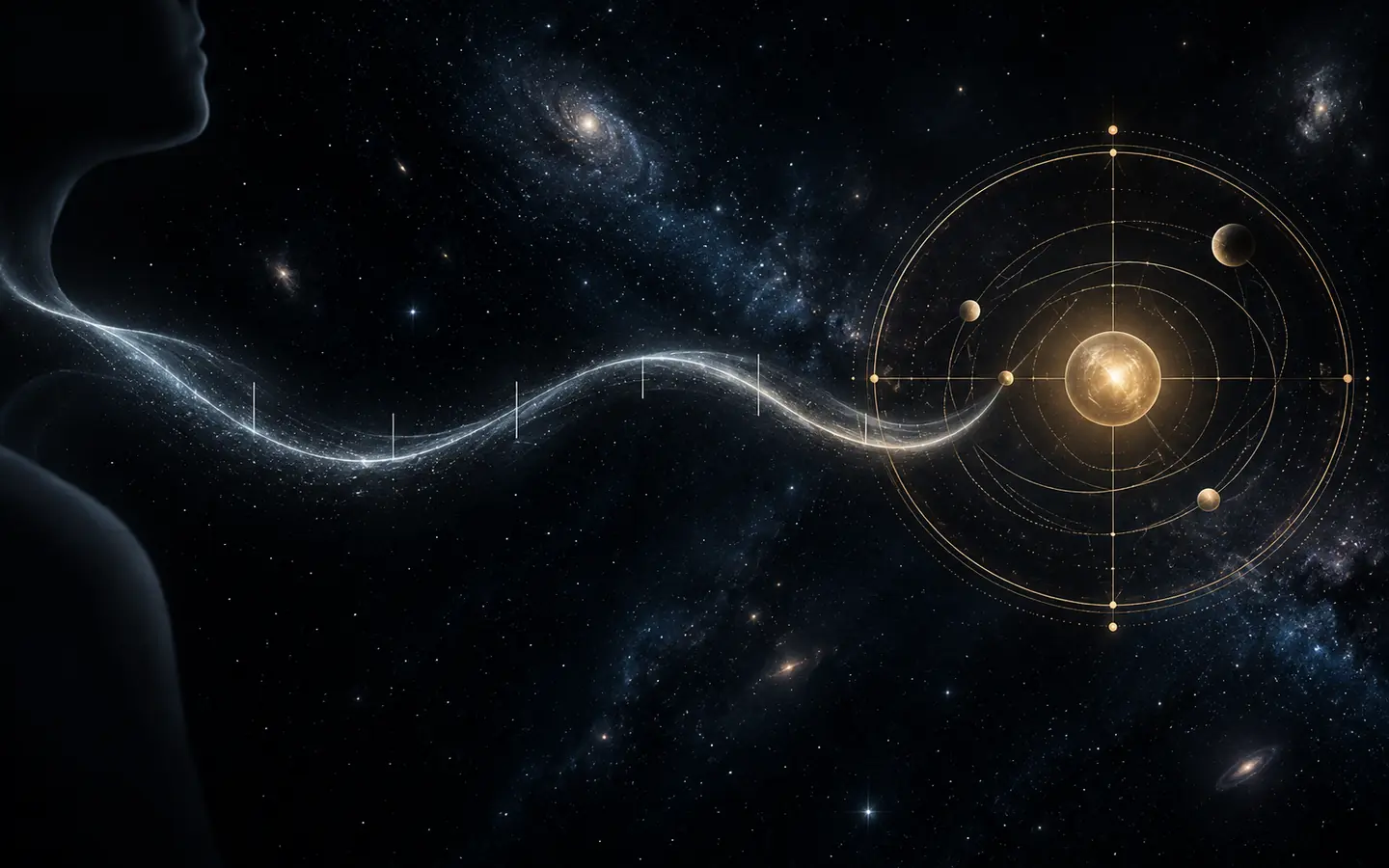

Chapter One · Foundations
If you think astrology begins with planets, signs and houses, you are missing its deepest secret. Astrology begins with something far more intimate: your breath.
That claim can sound almost upside down. Astrology appears to direct our attention outward—to the Moon, the planets, the zodiac and the horizon. Breath belongs to the body. What could the movement of air through your lungs possibly have to do with a chart?
The answer is not that breathing somehow pushes the planets, nor that two unlike processes must share a physical cause. The connection is more exact and more useful: both become intelligible through rhythm, interval and time.
If Jyotish reads the sky, why does Vedansh begin with the breath?
Because a planet, sign or house means nothing in isolation. Jyotish becomes possible only when the sky is read at a moment. A birth chart is not “the planets” in general. It is the ordered sky at a particular time and place. A transit matters because something has moved from one interval to another. A daśā is a sequence. A muhūrta is a chosen moment. Even prediction is an attempt to understand the quality of time.
Before we learn the symbols of Jyotish, then, we have to learn what makes them speak: time organised as rhythm.
The Vedansh learning path
From inner observation to celestial meaning
Think of clocks ticking at different scales. The clock nearest to you is not on the wall. It is already moving inside you.
- 01 · PresenceSelfThe observer who notices change.
- 02 · RecurrenceBreathA directly felt cycle of arrival and return.
- 03 · PatternRhythmRepetition makes intervals visible.
- 04 · MeasureTimeIntervals can be counted and compared.
- 05 · ScaleCelestial rhythmDay, month and year unfold through larger cycles.
- 06 · ReadingJyotishThe language used to interpret those ordered moments.
Part I · The hidden foundation
Before planets, there is time
Look at a clock with its hands removed. The numbered face remains, but it no longer tells you anything. In the same way, a catalogue of planets and signs is not yet Jyotish. It becomes Jyotish when position is joined to movement, movement to sequence, and sequence to a meaningful moment.
This is why the deeper subject of astrology is not a collection of objects floating far away. It is kāla—time—and the patterns by which time becomes legible. The grahas are among its hands. The zodiac is among its measuring circles. The horizon makes the measurement local. But the logic begins earlier: something changes, the change repeats, and an interval can be recognised.
Your breath supplies that logic without a telescope, an ephemeris or a belief system. You do not need to be told that an inhalation has arrived, or that an exhalation has passed. You experience succession directly.
Part II · The nearest clock
Breath is the rhythm nearest to you
A single breath is not yet a clock. But let it return and a pattern appears. One inhalation and exhalation form a cycle. One cycle follows another. Now there is a “before,” an “after,” and an interval between them.
This does not make the human breath perfectly mechanical. It changes with sleep, movement, emotion, illness, age and attention. That variation is part of why it is intimate. Yet beneath the variation lies recurrence. Breath gives the body an immediate way to encounter time not as an abstraction, but as lived rhythm.
Part III · Śiva Svarodaya
A tradition that asks the astrologer to read the breath
The reel names the Śiva Svarodaya, a Sanskrit work framed as a dialogue in which Devī Pārvatī questions Śiva. Its key term, svara, can mean sound or tone in Sanskrit; in this tradition it refers to the observed current of breath and the knowledge derived from it. Svarodaya is the “rising” or appearance of that current.
The text ranges far beyond the limited point needed for this chapter. It discusses nāḍīs, elemental classifications, daily practice, timing of actions, prognostication and yoga. We will not compress that whole system into a few paragraphs. What matters here is the priority it gives to observation of the breath before astrological judgment.
“An astrologer without the breath is a house without a master, a mouth without scripture, a body without a head.” Śiva Svarodaya, commonly numbered verse 17
That is not a decorative comparison added by a modern teacher. It is the tradition’s own challenge to the astrologer: do not read the sky while remaining blind to the rhythm through which time is experienced in the body.
Another verse in the received text links brahmāṇḍa, the cosmic “world-egg,” and piṇḍa, the embodied individual, through svara. In traditional language, this is the relation of macrocosm and microcosm: the larger order and the human being are not treated as two sealed domains. The breath becomes a site where that correspondence can be observed.
Textual note: what we can—and cannot—say about the Śiva Svarodaya
Part IV · The classical arithmetic
Why 21,600 is not a random number
The most striking calculation in the reel belongs to a broader Indian system of time-reckoning. The Sūrya Siddhānta, one of the foundational Sanskrit works of mathematical astronomy, places respiration at the beginning of measurable time:
Six respirations make one vināḍī; sixty vināḍīs make one nāḍī; sixty nāḍīs make a sidereal day and night.1
A day built from breath
The unit grows; the rhythm remains nested
- 1prāṇaone respiration in this metrological scheme
- 6prāṇasone vināḍī, often called a pala
- 60vināḍīsone nāḍī or ghaṭī
- 60nāḍīsone sidereal ahorātra: day and night
The familiar conventional equivalents make the nesting easy to see: a vināḍī or pala is approximately 24 seconds; a nāḍī or ghaṭī is approximately 24 minutes; sixty ghaṭīs complete the day-night cycle. The arithmetic is not something we are imposing on an unrelated text. It is explicit in the unit sequence itself.
| Classical term | Relation in the scheme | Conventional equivalent | Teaching purpose here |
|---|---|---|---|
| Prāṇa | One respiration | About 4 seconds | The bodily unit |
| Vināḍī / pala | 6 respirations | About 24 seconds | The first counted interval |
| Nāḍī / ghaṭī | 60 vināḍīs | About 24 minutes | A larger time division |
| Nākṣatra ahorātra | 60 nāḍīs | One sidereal day-night | The full celestial cycle named by the text |
Precision note: sidereal day and modern clock time
Vedansh Jyotish Circle
Want to know more, ask questions, or talk to Vedansh?
Join the Vedansh Jyotish Circle on WhatsApp. Bring your questions from this chapter, discuss what you are learning, and stay connected as new lessons are published.
A learning conversation · No prediction spam · Leave anytime
Before you join
This is a conversational WhatsApp group for Jyotish learners. Group members can see one another’s WhatsApp phone numbers.
Part V · The modern measurement
Does fifteen breaths per minute hold up?
Take the simple rate used in the reel:
15 breaths per minute × 60 minutes × 24 hours = 21,600 breaths.
Modern population data show that fifteen is not an arbitrary rate. A 2021 study using nocturnal data from 10,000 wearable-device users reported a mean respiratory rate of 15.4 breaths per minute, with 90% of values between 11.8 and 19.2.7 A 2025 population study of 2,224 adults found a median resting rate of 15.8 breaths per minute.8
These studies do not prove the Śiva Svarodaya, and they do not validate astrology by experiment. They establish the narrower—and important—point made in the reel: a rate close to fifteen breaths per minute is physiologically realistic at population scale. The traditional daily count rests near an observable human rhythm.
Part VI · From day to celestial circle
The same number measures a complete circle
Now move from time to angular space. A full celestial circle contains 360 degrees. Each degree contains 60 arcminutes:
360 degrees × 60 arcminutes = 21,600 arcminutes.
This is where the reel’s microcosm–macrocosm insight becomes precise. The classical day is enumerated as 21,600 respirations; the complete celestial circle is divided into 21,600 arcminutes. In one case, the whole is temporal. In the other, the whole is angular. The number joins two complete measures.
One correction makes this teaching stronger: the statement is not that every planet travels 360 degrees in one day. Planets have very different orbital and apparent motions. Rather, as Earth rotates, the celestial sphere completes a full relative turn in one sidereal day, while the ecliptic and every other full circle can be measured as 21,600 arcminutes. Modern astronomy likewise defines sidereal time through Earth’s rotation relative to the celestial reference frame.9
Correspondence
Body, day and celestial circle are read as nested expressions of ordered time. The equal count makes the inner and outer cycles commensurable.
Different mechanisms
Respiration and Earth’s rotation are distinct physical processes. Modern data support the breath-rate estimate and astronomical geometry—not a causal mechanism between them.
Interactive · From Breath to Time
Move between the clocks
Change the breathing rate to see how a small interval accumulates across a day. At fifteen breaths per minute, the classical daily count and the 21,600 arcminutes of a circle meet.
At 15 breaths per minute, the model reaches exactly 21,600 breaths in 24 hours.
A complete inhalation and exhalation gives the body one directly felt cycle.
This is an arithmetic learning model. Human respiratory rate varies, and the celestial circle does not physically cause the breath rate. Reduced-motion settings stop all animation while preserving the controls and values.
Part VII · Inner and outer rhythm
What “microcosm and macrocosm” actually means here
A useful analogy is a clock and its chime. The chime does not cause the hour, and the hour does not manufacture the chime. Yet the two can be coordinated because both participate in the same measured order.
The breath–day–circle relationship works in this way. It does not require us to pretend that lungs and planets are the same mechanism. It asks us to see that recurring inner experience can be placed within recurring outer cycles. A human rhythm becomes a unit of time; units form a day; the day is read against the celestial sphere.
This is the conceptual bridge the reel is building:
“Your breath is not separate from the day.”Vedansh Astrology · Reel 1
“Not separate” does not mean “physically identical.” It means the day is more than an astronomical fact outside you. You live it through cycles of waking and sleeping, activity and rest, attention and fatigue—and, continuously, through breath. The outer rotation and the inner rhythm meet in the human experience of time.
That is why the correspondence matters to Jyotish. Jyotish does not merely display distant objects. It relates a living observer to ordered celestial time. The chart is the grammar of that relation.
Part VIII · The Vedansh method
Why Vedansh Astrology begins here
Beginning with the breath changes the kind of student you become.
If we begin with a list of planetary meanings, astrology can quickly become a vocabulary to memorise—or a verdict to fear. If we begin with rhythm, you first learn to observe. You see that time is not empty space through which events happen. It has structure: cycles repeat, scales nest, and moments arise within larger movements.
The breath is therefore not a random spiritual flourish before the “real astrology” begins. It is the first lesson in the reasoning of Jyotish. It teaches three things at once:
Time can be experienced. You know rhythm before you calculate it.
Time can be measured. Repeated intervals can build a day.
Time can be read at different scales. The body, the horizon and the celestial circle do not collapse into one another, but they can belong to one coherent system of observation.
This is how we learn the language of time: not by surrendering agency to a prediction, but by understanding the architecture that makes astrological interpretation possible.
Clarity without fear. Depth without unnecessary complexity. Guidance without surrendering agency.
The First Breath and the Eastern Horizon
If Chapter One establishes that breath can open the study of time, the next lesson asks what happens at the first breath: why a specific sign rises on the eastern horizon, and how that meeting becomes the Lagna—the point where the sky begins to speak about a particular life.
Source transparency
Sources & Further Reading
The central teaching sequence—breath → time → celestial measure → Jyotish—comes from Vedansh Astrology’s Reel 1. The sources below distinguish the classical textual basis, modern scholarship and modern measurement used to deepen and verify that lesson.
Classical and traditional sources
- Sūrya Siddhānta, chapter 1, verses 10–12, Sanskrit with Ebenezer Burgess’s translation and notes: respiration, vināḍī, nāḍī and the sidereal day-night.
- Śiva Svarodaya, Sanskrit text, structural overview and selected translations, including the verses on the astrologer and on macrocosm–body correspondence.
- Swami Muktibodhananda Saraswati, Swara Yoga: The Tantric Science of Brain Breathing, Bihar School of Yoga. A widely used English exposition and translation of the received Śiva Svarodaya tradition.
Historical and interpretive scholarship
- Jason Birch, interview on yoga history and svarodaya research, Yoga Research, 2024: the textual field, prognostic uses and unresolved research questions.
- Magdalena Kraler, Yoga Breath: The Reinvention of Prāṇa and Prāṇāyāma in Early Modern Yoga, University of Vienna, 2022: textual and modern reception context for the Śivasvarodaya.
- Hart de Fouw and Robert Svoboda, Light on Life: An Introduction to the Astrology of India, Penguin: Jyotish as the study of time and the relation of internal and external measures.
Modern respiratory and astronomical measurement
- Natarajan et al., “Measurement of respiratory rate using wearable devices and applications to COVID-19 detection”, npj Digital Medicine 4 (2021): study of 10,000 users; mean nocturnal rate 15.4 breaths/minute.
- Rückert-Eheberg et al., “Respiratory rate and its associations with disease and lifestyle factors in the general population”, PLOS ONE 20 (2025): population sample of 2,224 adults; median resting rate 15.8 breaths/minute.
- U.S. Naval Observatory, “Sidereal Time”, with NASA’s worked explanation of the sidereal day: Earth’s rotation relative to the celestial reference frame and the 360-degree cycle.